
Best MBA Colleges in Chandigarh and Mohali
The Chandigarh and Mohali belt has become one of North India’s more serious places to study management. Within roughly forty kilometres you will find a campus of the Indian School of Business, an AACSB accredited school ranked inside the national top fifty, and several large private universities running MBA programmes at very different price points.
That range is useful, but it also makes the decision harder. A programme costing twelve lakh and one costing four lakh are not competing for the same person, and the marketing rarely says so. This guide sets out what each option realistically offers, what it costs in time as well as money, and how to tell which one fits your position.
Get free MBA admission guidance
Tell us which college interests you and we will send the current fees, eligibility and admission dates.
What you will receive
- Current fees, not last year's. The total two year cost including hostel, mess and one-time charges, which is the figure comparison sites usually miss.
- Which entrance tests count. CAT is not the only route here. We will tell you whether your existing MAT, CMAT or NMAT score is already enough.
- Whether you are eligible. Checked against your actual marks and year of graduation before you spend anything on an application.
- Real admission dates. Registration windows close months before the exam, and missing one costs a full year.
- Scholarships you may qualify for. Including the merit waivers that are rarely advertised until you ask directly.
No charge, and no pressure. We are not an agent for any college and we are not paid to steer you toward one. If a programme is a poor fit for your position, we will say so.
Most enquiries are answered within one working day.
Why this region works for management education
Three things make the Chandigarh, Mohali and Dera Bassi corridor worth considering rather than simply convenient.
The first is employer density. Mohali’s IT City and the surrounding industrial areas hold technology firms, pharmaceutical companies, banking back offices and manufacturing units. Summer internships and final placements do not require a flight. For a student without family money behind them, that difference in travel and living costs is not trivial.
The second is cost of living. Hostel and rental costs here sit well below Delhi NCR, Bengaluru or Mumbai. Two years of that difference can amount to more than a lakh, which is worth weighing against a marginally better ranked school elsewhere.
The third is the spread of options. Very few regions offer a one year programme for experienced professionals, a nationally ranked two year MBA, and several mid-priced private MBAs inside the same commuting radius. You can choose by fit rather than by what happens to be nearby.
The colleges, and who each one actually suits
Rankings tell you how an institution compares. They do not tell you whether it suits your circumstances, which is the more useful question. Here is how these seven differ in practice.
Indian School of Business, Mohali
ISB is the most selective name on this list, and it is also the one most people apply to without checking whether they are eligible. The flagship Post Graduate Programme in Management is one year, not two, admission runs on GMAT or GRE rather than CAT, and it is designed for people who already have meaningful work experience. A final year student cannot walk into it.
If you have four or more years behind you and are looking to change function or accelerate, ISB is a genuinely different proposition from everything else here. If you are graduating this year, it is not yet your option, and applying anyway wastes an application cycle.
LM Thapar School of Management, Dera Bassi
LMTSM is part of the Thapar Institute of Engineering and Technology and has been running since 2007. It was ranked 46th in the NIRF management category in 2025 and holds AACSB accreditation, which relatively few Indian business schools have earned. Its 2025 placement reporting shows a highest package of around 24.8 lakh, with recruiters including Deloitte, KPMG, TCS and American Express.
It accepts CAT, NMAT, CMAT and XAT scores as well as its own entrance test, which widens the route in for candidates who did not sit CAT. The campus is in Dera Bassi, some distance from Chandigarh city, and that isolation divides opinion. Students who want a residential, study-focused two years tend to like it. Students who want city life on a weekday evening tend not to.
This is the strongest conventional two year MBA in the immediate region, and the fees reflect that.
Chandigarh University, Gharuan
Chandigarh University runs management at scale, with NAAC A+ accreditation and a strong NIRF management position. Its recruitment activity is heavy, its specialisation list is long, and it accepts CUCET alongside national scores, so admission does not hinge on one exam.
Scale cuts both ways. Facilities and recruiter footfall are genuinely good. Individual attention is harder to come by than at a smaller school, and outcomes vary noticeably by specialisation and by how much the student pushes. Worth visiting in person and asking to speak to current second year students rather than only the admissions team.
Chitkara Business School, Chitkara University
Chitkara Business School was set up in 2011 within Chitkara University, which holds NAAC A+ accreditation. Its distinguishing feature is specialisation choice rather than headline ranking. Alongside finance, marketing and human resources it runs pharmaceutical management and healthcare management, which connect directly to the pharma cluster around Baddi and the hospital sector in the tricity.
If you want to enter pharma or healthcare commercially, that is a real advantage and one that a higher ranked general programme will not give you. If you want mainstream corporate finance, the case is less distinct.
Amity University Punjab, Mohali
Amity’s Mohali campus sits in Sector 82A, inside the IT City corridor. That location is the point. Guest lectures, live projects and internships with nearby technology firms are logistically easy in a way they are not from a campus forty kilometres out.
Amity is a national brand with recognisable infrastructure, and it prices accordingly. Students consistently raise return on investment as the thing to think hardest about before committing, which is a fair question to put to the admissions team directly.
CGC University, Jhanjeri
CGC Jhanjeri, part of the Chandigarh Group of Colleges, has grown quickly and focuses heavily on placement preparation, skill workshops and entrepreneurship support. It is a practical choice for a student who wants structured training towards a first corporate job rather than an academically demanding two years.
Chandigarh Business School of Administration, Landran
CBSA sits at the Landran campus of the same group. It is generally the lower fee option among the private choices here, which makes it worth a look for candidates who are financing the degree themselves and want to keep borrowing down. Ask specifically about placement figures by specialisation rather than overall, because that is where the variation lives.
Compare all seven colleges side by side
The descriptions above explain what each institution is like. The table below lets you rank them against each other on the things that usually decide it, which are cost, programme length, which entrance test you need and how far the campus sits from where you live.
MBA colleges in Chandigarh and Mohali compared
Sorted by fee band, lowest first. Scroll sideways on a small screen, or read the cards below.
| College | Fee band | Programme | Entrance accepted | Established | Accreditation and standing | Location |
|---|---|---|---|---|---|---|
| CGC University Jhanjeri Campus on Sirhind Road | Lower Lower range, one of the more affordable options | 2 yearsTwo year full time MBA | University test, CAT, MAT or CMAT | 2012 (Jhanjeri campus) | NAAC accreditedPlacement focused | Jhanjeri, Sirhind Road, Mohali |
| CBSA Landran Landran campus | Lower Generally the lowest fee option in this list | 2 yearsTwo year MBA, affiliated programme | CAT, MAT, CMAT or the state entrance route | 2001 (group) | Affiliated, NAAC accredited groupEstablished regional college | Sector 112, Landran, Mohali |
| Chandigarh University Large multi-discipline campus | Mid range Mid range, with merit scholarships that move it noticeably | 2 yearsTwo year full time MBA with dual specialisation | CUCET, CAT, MAT, XAT or CMAT | 2012 | NAAC A+QS 401 to 450 Business and Management (2025) | Gharuan, NH-05, Mohali district |
| Chitkara Business School Campus on the Patiala highway | Mid range Mid range, varies a lot by specialisation | 2 yearsTwo year full time MBA | CAT, MAT, NMAT, XAT, CMAT or a university test | 2011 (business school) | NAAC A+Strong regional standing | Jansla, Rajpura, on the Chandigarh Patiala highway |
| Amity University Punjab Inside the IT City corridor | Mid range Mid to upper range for the region | 2 yearsTwo year full time MBA | Amity written test and interview, or a national score | 2012 | UGC recognised, NAAC accreditedNational Amity network | Sector 82A, IT City Road, Mohali |
| LM Thapar School of Management 26 acre residential campus | Higher Highest of the two year programmes in this list | 2 yearsTwo year full time MBA | CAT, NMAT, CMAT, XAT or the institute TMAT | 2007 | AACSB, NAAC A++NIRF Management 46 (2025) | Dera Bassi, District Mohali |
| ISB Mohali Knowledge City campus | Premium Substantially higher than every other option here, in the tens of lakhs | 1 yearPost Graduate Programme in Management (PGP) | GMAT or GRE | 2012 (Mohali campus) | Autonomous, globally accreditedTop ranked private B-school in India | Knowledge City, Sector 81, Mohali |
CGC University Jhanjeri
Jhanjeri, Sirhind Road, Mohali
Lower- Programme
- 2 years, Two year full time MBA
- Entrance
- University test, CAT, MAT or CMAT
- Established
- 2012 (Jhanjeri campus)
- Standing
- NAAC accredited. Placement focused
CBSA Landran
Sector 112, Landran, Mohali
Lower- Programme
- 2 years, Two year MBA, affiliated programme
- Entrance
- CAT, MAT, CMAT or the state entrance route
- Established
- 2001 (group)
- Standing
- Affiliated, NAAC accredited group. Established regional college
Chandigarh University
Gharuan, NH-05, Mohali district
Mid range- Programme
- 2 years, Two year full time MBA with dual specialisation
- Entrance
- CUCET, CAT, MAT, XAT or CMAT
- Established
- 2012
- Standing
- NAAC A+. QS 401 to 450 Business and Management (2025)
Chitkara Business School
Jansla, Rajpura, on the Chandigarh Patiala highway
Mid range- Programme
- 2 years, Two year full time MBA
- Entrance
- CAT, MAT, NMAT, XAT, CMAT or a university test
- Established
- 2011 (business school)
- Standing
- NAAC A+. Strong regional standing
Amity University Punjab
Sector 82A, IT City Road, Mohali
Mid range- Programme
- 2 years, Two year full time MBA
- Entrance
- Amity written test and interview, or a national score
- Established
- 2012
- Standing
- UGC recognised, NAAC accredited. National Amity network
LM Thapar School of Management
Dera Bassi, District Mohali
Higher- Programme
- 2 years, Two year full time MBA
- Entrance
- CAT, NMAT, CMAT, XAT or the institute TMAT
- Established
- 2007
- Standing
- AACSB, NAAC A++. NIRF Management 46 (2025)
ISB Mohali
Knowledge City, Sector 81, Mohali
Premium- Programme
- 1 year, Post Graduate Programme in Management (PGP)
- Entrance
- GMAT or GRE
- Established
- 2012 (Mohali campus)
- Standing
- Autonomous, globally accredited. Top ranked private B-school in India
Why we show a band rather than a number. MBA fees in this region change every admission cycle and vary by specialisation, hostel category and any scholarship you qualify for. The figures published on comparison sites frequently contradict each other and are often a year out of date, and people plan real money around them. A band lets you rank the options honestly. For the actual figure for this cycle, use the enquiry form above and we will send it.
Specialisations on offer, and where each one leads
Most applicants choose a college first and a specialisation later, usually in the second semester. That order is backwards for anyone with a clear target industry, because the specialisation determines which recruiters will look at you, and not every college is strong in every stream.
| Specialisation | Typical entry roles | Who it suits |
|---|---|---|
| Finance | Credit analyst, equity research associate, corporate finance executive, banking officer | Candidates comfortable with numbers who are willing to add certifications alongside the degree |
| Marketing and sales | Territory sales manager, brand executive, digital marketing associate | The widest recruiter base in this region and the most common first placement |
| Human resources | HR generalist, talent acquisition executive, HR business partner trainee | Smaller intake and fewer openings, but less internal competition |
| Operations and supply chain | Supply chain analyst, plant operations trainee, logistics executive | Engineering graduates, who tend to convert these roles more easily |
| Business analytics | Business analyst, data analyst, reporting associate | Candidates willing to learn SQL, Excel modelling and a visualisation tool properly |
| Pharmaceutical and healthcare management | Product executive, medical representative to management track, hospital administration | Directly relevant to the Baddi pharma belt and tricity hospital sector |
| International business | Export documentation, trade operations, sourcing executive | A narrower market than the name suggests; ask for actual placement data |
One caution on analytics. It is the fastest growing label on Indian MBA brochures, and the gap between colleges that teach it seriously and colleges that have renamed an IT elective is enormous. Ask which software is taught, how many hours of lab time the semester carries, and what the last cohort of analytics students actually did after graduating. Vague answers to those three questions tell you what you need to know.
What an MBA here actually costs
Published fee figures move every admission cycle and vary by specialisation, so treat any number you read online, including on this page, as an indication rather than a quote. As a rough shape at the time of writing, the nationally ranked two year programmes in this region run into double figures in lakhs once hostel and one-time charges are included, while the mid-tier private MBAs sit substantially below that.
Two costs are routinely left out of the comparison. The first is two years of forgone salary, which for someone already earning is often larger than the tuition. The second is interest on an education loan, which on a ten lakh borrowing over a long tenure adds a significant amount to the real total. Work out the full figure before comparing schools, because it changes which one looks sensible.
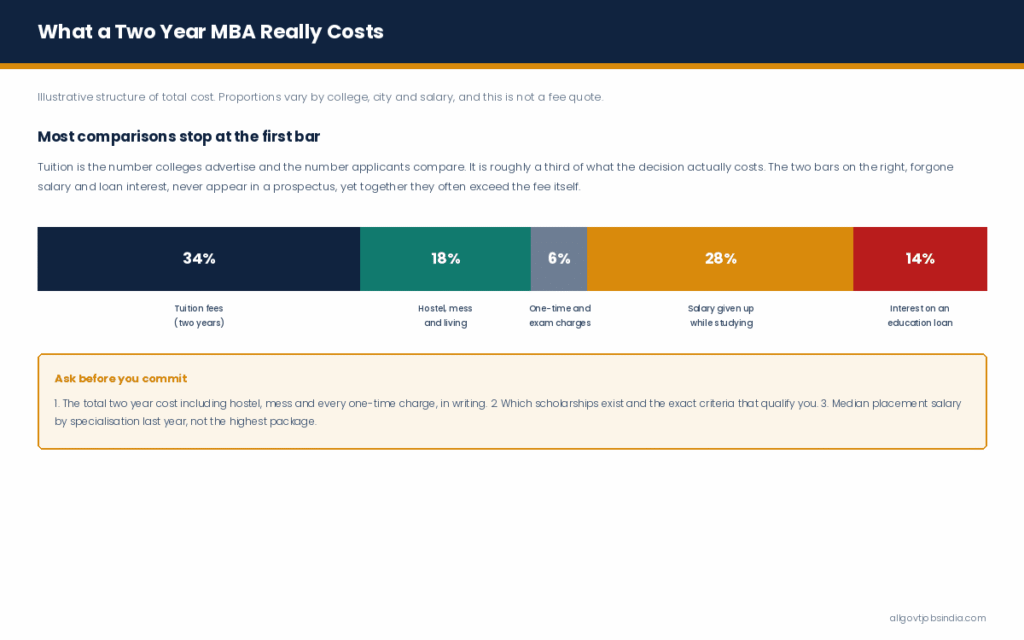
Ask every college three questions in writing. What is the total two year cost including hostel, mess and every one-time charge. What scholarships exist and what exactly qualifies you for them. What was the median placement salary last year, not the highest. The gap between median and highest is where a lot of disappointment comes from.
Living costs in the tricity
Living costs are the part of the budget you control, and they vary more than tuition does. A student in a shared hostel room eating in the mess spends a fraction of what a student renting privately in Sector 70 spends. Neither is wrong, but only one of them is affordable on a loan.
- Campus hostel with mess. The cheapest and the least negotiable. Confirm whether the mess charge is annual or per semester, and whether it is compulsory even if you eat elsewhere.
- Shared private accommodation. Common around Landran, Gharuan and Kharar. Cheaper per head than a single room, but adds a daily commute and a deposit.
- Living at home. Removes the single largest controllable cost, and is the reason the campus locations above matter. An hour each way in shared transport is a real cost in energy even when it is free in money.
- The costs nobody budgets. Laptop, formal clothing for interviews, certification courses, case competition travel and a phone plan that survives two years. Set aside something for these rather than discovering them in month three.
Education loans and scholarships
Most public sector banks lend for management education, and the terms are more favourable than a general personal loan. A few points are worth understanding before you sit down with a bank.
Interest usually accrues during the course even though repayment starts after a moratorium, so the amount you owe on graduation day is larger than the amount you borrowed. Ask whether servicing simple interest during the study period is permitted, because it often is and it reduces the final burden noticeably. Collateral requirements typically kick in above a threshold, and that threshold is a genuine reason some candidates choose a lower fee college. Finally, tax relief on education loan interest exists under the Income Tax Act and is worth raising with the bank, though the specifics depend on your own position and are a question for a qualified adviser rather than a website.
On scholarships, the useful question is not whether they exist but what proportion of the intake receives one and on what basis. Merit waivers tied to entrance percentile are the most predictable. Waivers described vaguely at the counselling desk are the least. Get the criteria in writing before you treat a discount as real.
Entrance exams and eligibility
The baseline for a two year MBA is a bachelor’s degree in any discipline, usually with at least 50 per cent aggregate and a relaxation of around 5 per cent for reserved categories. Final year students can generally apply, with admission conditional on their result.
On entrance tests, the practical position in this region is that CAT is not the only door. LM Thapar accepts NMAT, CMAT, XAT and its own test. Chandigarh University accepts CUCET as well as national scores. Chitkara accepts several national tests and a university test. ISB is the exception and runs on GMAT or GRE.
That matters for planning. A candidate who did not sit CAT this year still has routes open, and one who has already taken CMAT or MAT should check which of these colleges accept it before assuming another year is required.
How to get admission in MBA colleges
Admission looks complicated from the outside and is fairly mechanical once you understand the order. Every institution in the list of best MBA colleges in Chandigarh above follows broadly the same six steps, and the only real variation is which entrance score each one accepts.
- Check you meet the basic eligibility. A bachelor’s degree in any subject with the minimum aggregate the college states. Final year students can usually apply.
- Register for an entrance test you can realistically sit. If you already hold a valid MAT, CMAT, NMAT or XAT score, several of the top MBA colleges in Chandigarh will accept it as it stands.
- Apply to three or four colleges, not one. Application fees are small compared with losing a year. Spread your applications across one ambitious choice, two realistic ones and a safe option.
- Prepare for the group discussion and personal interview. Most private universities weight this heavily. Panels ask why this college, why this specialisation and what you did last year, so have honest answers ready.
- Accept an offer and arrange the money. The gap between an offer and its fee deadline is often shorter than a bank takes to sanction a loan, so start that conversation while you are still interviewing.
- Complete document verification and joining. Originals are checked at this stage, and a mismatch between your name or date of birth across certificates will hold things up.
The step most people skip is the second one, because they assume CAT is compulsory. It is not, and that single misunderstanding sends candidates into an unnecessary extra year of preparation every cycle.
If you would rather not work through this alone, fill in the form below and we will contact you about admission. Tell us which college interests you and we will come back with the current fees, the entrance tests that college accepts, whether your existing score already qualifies, and the exact dates for this cycle. There is no charge and we are not an agent for any institution.
Get free MBA admission guidance
Tell us which college interests you and we will send the current fees, eligibility and admission dates.
What you will receive
- Current fees, not last year's. The total two year cost including hostel, mess and one-time charges, which is the figure comparison sites usually miss.
- Which entrance tests count. CAT is not the only route here. We will tell you whether your existing MAT, CMAT or NMAT score is already enough.
- Whether you are eligible. Checked against your actual marks and year of graduation before you spend anything on an application.
- Real admission dates. Registration windows close months before the exam, and missing one costs a full year.
- Scholarships you may qualify for. Including the merit waivers that are rarely advertised until you ask directly.
No charge, and no pressure. We are not an agent for any college and we are not paid to steer you toward one. If a programme is a poor fit for your position, we will say so.
Most enquiries are answered within one working day.
Eligibility for MBA colleges
Eligibility is where applications quietly fail, usually over a detail nobody mentioned. The requirements below apply to the two year programmes among the MBA colleges in Mohali and Chandigarh. Confirm each one against the notification for your own intake, because individual colleges do vary.
| Requirement | What it usually means |
|---|---|
| Qualifying degree | A bachelor’s degree of at least three years in any discipline from a recognised university |
| Minimum marks | Commonly 50 per cent aggregate, with around 45 per cent for SC, ST and PwD candidates |
| Final year students | Generally permitted to apply, with admission conditional on the final result |
| Entrance score | CAT, MAT, CMAT, XAT, NMAT, CUCET or a university test, depending on the college |
| Age limit | No upper age limit at most private universities, unlike government recruitment |
| Work experience | Not required for two year programmes. Expected for ISB and for executive formats |
Two points are worth knowing before you apply. Aggregate usually means the average across all years of your degree rather than your best year, so check how your university calculates it. And a category certificate has to be in the prescribed format and valid on the cut-off date, because an expired certificate is treated as no certificate and your application is then assessed at the general threshold.
Is Chandigarh University good for MBA?
This is the most common question we receive about doing an MBA in Chandigarh, and it deserves a straight answer rather than a marketing one.
On the evidence, Chandigarh University MBA is a strong option in this region. It holds NAAC A+ accreditation, it places well in the NIRF management category, and QS placed it in the 401 to 450 band globally for business and management in its 2025 subject rankings, which very few private Indian universities reach. Recruiter footfall on campus is high and the specialisation list is broad, including analytics and international business alongside the standard streams.
The honest qualification is scale. Chandigarh University admits a large management cohort, and a large cohort means the experience varies more than it would at a small school. Students who use the placement cell early, take part in case competitions and build relationships with faculty tend to do well. Students who wait for the college to organise their career find that individual attention is harder to come by than the brochure suggests.
So the useful version of the question is not whether the university is good, but whether it suits how you work. If you are self-directed and want breadth of opportunity, it is among the top MBA colleges in Chandigarh for exactly that reason. If you want a small cohort and close supervision, look at LM Thapar or Chitkara instead and compare their medians directly.
Chandigarh University MBA fees
We are deliberately not printing a fee figure here, and it is worth explaining why. Chandigarh University MBA fees change every admission cycle, vary by specialisation, and differ again depending on hostel category and any scholarship you qualify for. Comparison sites carry numbers that are frequently a year old, and applicants who plan around them get an unpleasant surprise at the counselling desk.
What is stable is the structure of the cost, and knowing that structure lets you ask the right questions:
- Tuition, quoted per semester or per year. Always convert it to the full two year figure before comparing colleges.
- Hostel and mess, which vary by room sharing and are sometimes compulsory in the first year.
- One-time charges covering admission, registration, examination and a refundable security deposit.
- Scholarship waivers, usually tied to entrance percentile or past academic performance, which can move the real figure substantially.
Ask for the total two year cost in writing, including every one of those heads, and ask what proportion of the intake actually receives the scholarship you are being shown. A discount described verbally at a counselling desk is not a discount until it is on paper. If you want the current figures for this cycle, use the enquiry form on this page and we will send them across.
Career scope after MBA
An MBA is a general management qualification, so the career scope depends far more on your specialisation, your internship and your own effort than on the degree itself. That said, the pattern of outcomes in this region is reasonably predictable.
Most first placements sit in one of five areas. Sales and business development absorbs the largest share and has the widest recruiter base. Finance roles cover credit analysis, corporate finance and banking operations. Human resources takes a smaller intake but faces less internal competition. Operations and supply chain suits engineering graduates, who convert those roles more easily. Analytics is growing fastest and rewards anyone who learned the tools properly rather than treating the elective as a label.
MBA jobs in Chandigarh and the wider tricity
The local market is genuinely useful for a first job, though it is worth being realistic about its shape. MBA jobs in Chandigarh cluster around the IT and technology firms in Mohali IT City, banking and financial services across the tricity, the pharmaceutical belt running towards Baddi, education and healthcare administration, and a growing set of startups in the Mohali corridor.
Location matters here in a practical way. Campuses inside the IT City corridor, which includes Amity University Mohali, sit close enough to those employers that live projects and internships are easy to arrange. That proximity is one of the real arguments for an Amity University Mohali MBA over an equivalent programme further out, and it is the kind of advantage that does not appear in any ranking table.
Two honest caveats. Salaries in the tricity generally sit below Gurgaon, Bengaluru and Mumbai for the same role, so candidates chasing the highest first package often move after two or three years. And the local market is smaller, which means networking counts for more than it does in a metro. The students who place best here start attending industry events in their first year rather than their last.
The public sector route
Management graduates are also recruited directly by public sector undertakings, banks and regulators, often through management trainee schemes that pay competitively and carry the security a private role does not. This is a genuine alternative rather than a fallback, and it is covered in more detail further down this page.
The admission timeline, month by month
The sequence below is the single most useful thing on this page for anyone deciding when to start. Each stage depends on the one before it, and none of them can be compressed.
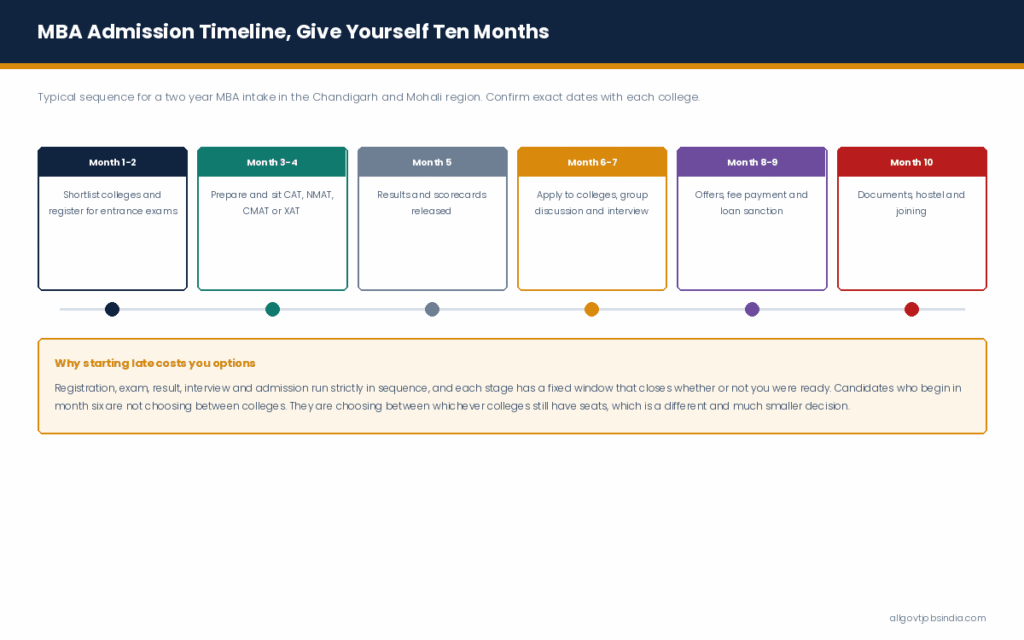
Two stages catch people out. Registration windows for the national entrance tests close months before the exam, and missing one costs a full year regardless of how ready you were. And the gap between an offer and the fee deadline is often shorter than a loan sanction takes, so start the bank conversation while you are still interviewing rather than after you have an offer letter in hand.
Documents you will need, and getting them upload-ready
Every college portal asks for broadly the same set, and the most common reason an application stalls is not eligibility but a file that will not upload. Assemble these before the window opens rather than during it.
- Class 10 certificate, which is also the accepted proof of date of birth
- Class 12 mark sheet and certificate
- Graduation mark sheets for every semester or year, plus the degree or provisional certificate
- Entrance exam scorecard for CAT, MAT, CMAT, XAT, NMAT, CUCET, GMAT or GRE as applicable
- Recent passport size photograph and a scanned signature
- Category certificate where a reservation or fee concession is claimed
- Migration and transfer certificates, needed at joining rather than at application
- Work experience letters if you are applying to a programme that counts them
Admission portals enforce strict limits on file dimensions and size, and they reject silently more often than they explain. If your photograph or signature is the wrong size, our free photo and signature resizer will bring it to spec in a few seconds. Where several mark sheets need to go up as one document, the JPG to PDF converter merges scans into a single clean file, and if the result is still too heavy for the upload limit, the PDF compressor will reduce it without making the text unreadable. All three run in your browser, so nothing is uploaded anywhere.
Reading placement numbers honestly
Placement reporting is the least standardised part of Indian management education, and the figure printed largest is almost always the least representative. A single exceptional offer sets the highest package. It tells you what the ceiling was for one person in one year. It tells you nothing about what you are likely to earn.
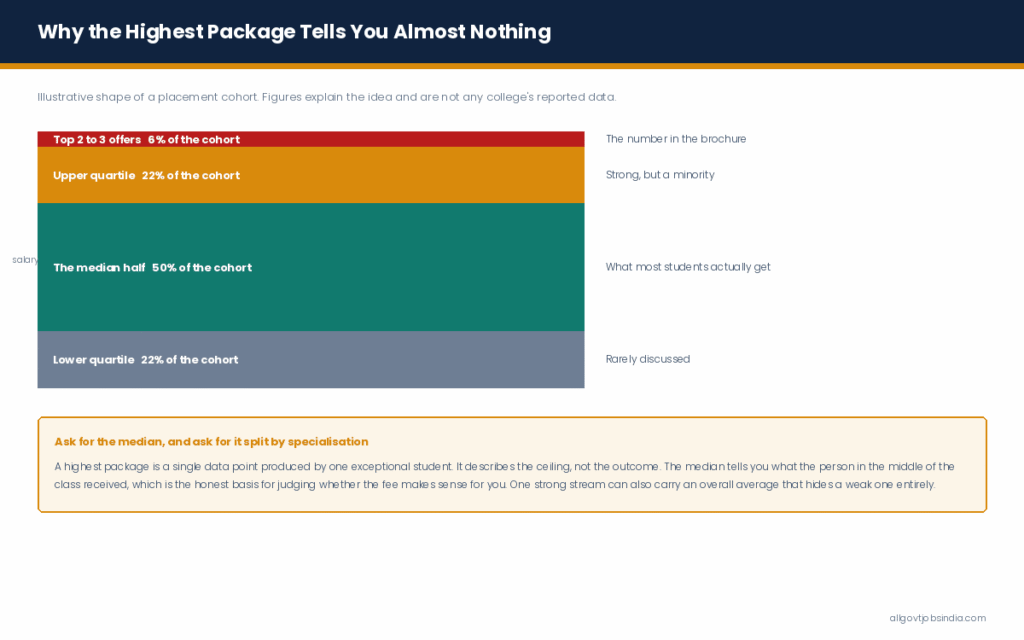
Four questions separate a serious placement conversation from a sales one. What was the median salary, not the average and not the highest. What percentage of the eligible batch was placed, and how is eligible defined, because students who opt out are often excluded from the denominator. What was the split by specialisation. And which recruiters returned this year having also recruited last year, because repeat recruiters indicate a working relationship rather than a one-off campus visit.
A college confident in its outcomes will answer all four without hesitation. Hesitation is itself an answer.
Options for people who are already working
If you are two or three years into a job, the full time two year MBA is often the wrong instrument, and it is worth saying so plainly on a page designed to generate enquiries. Leaving a salaried role to study full time makes sense when you need to change function or industry, because a career switch usually needs the campus placement process to work. It makes much less sense when you want the same work at a better employer, which is a problem a degree solves expensively and a good CV solves cheaply.
Three alternatives are worth checking in this region. Executive MBA formats run at weekends and are built for people with several years of experience. Part time and evening programmes take longer but let you keep earning. And the one year format at ISB compresses the whole thing, though it demands both the work experience and the GMAT or GRE score to get in.
The comparison that matters is not two year versus one year. It is total cost including the salary you give up, set against the specific outcome you are buying. Write both numbers down before you visit a campus.
Warning signs at the admissions desk
Most colleges in this region are straightforward. A few sales practices recur often enough to be worth naming, and recognising them protects you more than any ranking will.
- Pressure to pay a booking amount today. A seat that disappears unless you decide within the hour was never a considered decision. Ask for the offer in writing with a stated validity date.
- A guaranteed placement claim. No institution can guarantee employment. What can be documented is last year’s placement percentage and median, and that is what you should ask for instead.
- Recruiter logos with no year attached. A company that visited once in 2019 stays on the wall indefinitely. Ask which of those logos recruited from the last two batches.
- A fee quoted per year when the comparison is per programme. Always convert to the total two year figure including hostel, mess and one-time charges before comparing two colleges.
- Reluctance to let you speak to current students unsupervised. The most informative ten minutes of any campus visit happens in the canteen, not the conference room.
Choosing between an MBA and a government job
A good number of readers of this site are weighing both at once, and it is worth being direct about the trade-off rather than pretending one is obviously better.
A government post offers security, a defined pay structure, predictable progression and pension arrangements. It costs you time at the front end, because preparation runs in cycles and results are slow, and it caps how quickly earnings can rise. An MBA costs money and two years, offers no guarantee, and has a far wider range of outcomes at both ends.
Two practical points. Age limits for most government posts are firm, and two years spent on an MBA is two years of eligibility gone, so check your remaining window before deciding. Our age calculator works out your exact age against a given cut-off date, which is how almost every recruitment notice defines eligibility. And an MBA does not close the government route, because public sector undertakings, banks and several regulators recruit management graduates directly, sometimes on better terms than the general entry route.
That last point is not theoretical. Management trainee and executive entry schemes run every year and are open to exactly the profile an MBA produces. Live examples on this site include HAL Management and Design Trainee Recruitment 2026, which carries 120 posts with absorption at Grade II, and RCFL Management Trainee Recruitment 2026 with 94 seats across fourteen disciplines. For finance and marketing specialists, Kerala Cashew Board Manager Recruitment 2026 asks specifically for an MBA, and NIPER Guwahati CEO Recruitment 2026 is open to MBA holders with ten years of cross-sector experience.
Banking is the other established destination. PNB LBO Recruitment 2026 hires officers directly into the junior management grade, IBPS Clerk Recruitment 2026 runs the largest graduate intake in the sector at 11,403 posts, and CFSL Recruitment 2026 takes freshers into Assistant Manager roles in accounts and business development. Engineering graduates who add an MBA often target executive entry schemes such as SJVN Executive Recruitment 2026.
People who manage both well usually sequence them deliberately rather than attempting both at once. Splitting preparation across CAT and a competitive government exam in the same year tends to produce two mediocre results. If you are keeping the government option open while you study, our latest government jobs listing and the closing soon page are the two worth checking weekly, and many clerical and assistant grade posts include a speed requirement you can practise on our online typing test.
How to shortlist properly
- Visit the campus on a working day. Not an open day. You learn more from a normal Tuesday than from an event arranged to impress you.
- Talk to second year students, not the admissions desk. Ask what they would do differently. The answer is usually candid and usually useful.
- Ask for placement data by specialisation. An overall average hides a lot when one stream places well and another does not.
- Check who actually teaches the core courses. Visiting faculty for a guest session is not the same as teaching a semester.
- Work out the travel. A campus that is forty minutes away in an auto rickshaw at seven in the morning is a different proposition from one on a bus route.
Common questions
Can I do an MBA here without a CAT score?
Yes. Most private universities in this region accept MAT, CMAT, XAT, NMAT or their own entrance test. ISB is the exception and requires GMAT or GRE.
Is a two year MBA worth it if I already have a job?
It depends on whether you need a change of function or only a change of employer. If it is the latter, the cost of two years out is difficult to justify. Executive and part time formats exist and are often the better fit for someone already working.
Which of these colleges is best for placements?
On published figures, LM Thapar and Chandigarh University report the strongest outcomes among the two year programmes here. Compare median rather than highest packages, and by specialisation, before drawing a conclusion for your own case.
How early should I start the process?
Give yourself at least eight to ten months. Entrance registration, the exam itself, results, interviews and admission run in sequence, and candidates who start late end up choosing from whatever still has seats rather than from what they wanted.
Can final year students apply?
For the two year programmes, generally yes, with admission conditional on your final result and on meeting the minimum aggregate. ISB is different, because its programme is built around candidates who already have work experience.
Does the specialisation have to be decided at admission?
At most colleges here the first year is common and the specialisation is chosen in the second or third semester, sometimes subject to internal merit. If you have a specific target such as pharmaceutical management, confirm at admission that the stream will actually run, because niche electives are occasionally withdrawn when too few students opt in.
Is an education loan easy to get for these colleges?
Public sector banks lend against admission to recognised institutions, and the accreditation and ranking of the college affect both the amount and the collateral requirement. Start the conversation with your bank while you are still interviewing, because sanction can take longer than the gap between an offer and its fee deadline.
Should I pick a higher ranked college further away or a mid-tier one nearby?
If the ranking gap is large and the placement medians genuinely differ, the better school usually justifies the travel and the cost. If the gap is small, the nearer option often wins once you add two years of accommodation, travel and the practical ease of attending interviews and internships from home.
Get the current details for the college you want
Fees, intake and admission dates change every cycle, and the figure published on a comparison site is often a year out of date. Use the enquiry form on this page and tell us which college interests you. We will come back with the current fee structure, eligibility, accepted entrance tests and the admission timeline, at no cost.
MBA college locations in Chandigarh and Mohali
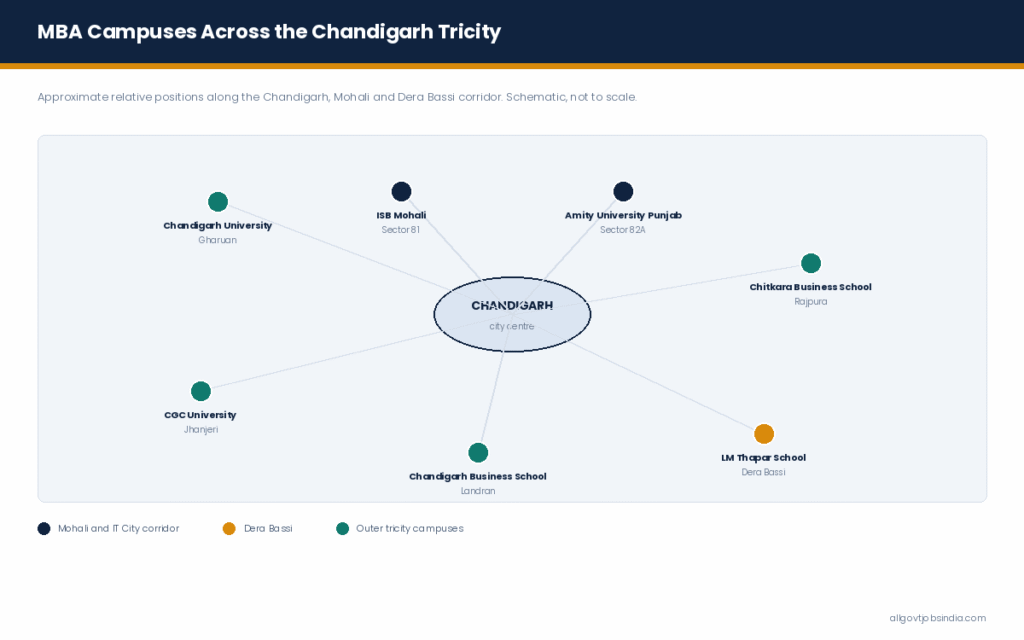
Travel time matters more than prospectuses suggest, particularly if you plan to live at home. The seven campuses are spread from Rajpura in the south to Gharuan in the north west, and the difference between them can be over an hour in traffic. Open a map on any of the cards below to see where it sits relative to you.
Indian School of Business (ISB), Mohali
Knowledge City, Sector 81, Mohali
- Programme
- Post Graduate Programme in Management (PGP)
- Duration
- 1 year
- Entrance accepted
- GMAT or GRE
Work experience expected. This is a one year PGP rather than a two year MBA, and it is aimed at people already several years into a career.
Knowledge City, Sector 81, Sahibzada Ajit Singh Nagar, Punjab 140306
LM Thapar School of Management, Dera Bassi
Dera Bassi, District Mohali
- Programme
- Two year full time MBA
- Duration
- 2 years
- Entrance accepted
- CAT, NMAT, CMAT, XAT or the institute TMAT
Ranked 46th in the NIRF Management category in 2025 and holds AACSB accreditation, which relatively few Indian business schools have.
Dera Bassi Campus, Off Derabassi Barwala Road, Behra, Punjab 140507
Chandigarh University, Gharuan
Gharuan, NH-05, Mohali district
- Programme
- Two year full time MBA with dual specialisation
- Duration
- 2 years
- Entrance accepted
- CUCET, CAT, MAT, XAT or CMAT
Large campus with a wide specialisation list and heavy on campus recruitment activity. NAAC A+ accredited.
NH-05, Ludhiana Chandigarh Highway, Gharuan, Punjab 140413
Chitkara Business School, Chitkara University
Jansla, Rajpura, on the Chandigarh Patiala highway
- Programme
- Two year full time MBA
- Duration
- 2 years
- Entrance accepted
- CAT, MAT, NMAT, XAT, CMAT or a university test
Established 2011. Unusual specialisations alongside the standard ones, including pharmaceutical and healthcare management, which suit the pharma industry around Baddi and Mohali.
Chandigarh Patiala National Highway NH-64, Village Jansla, Rajpura, Punjab 140417
Amity University Punjab, Mohali
Sector 82A, IT City Road, Mohali
- Programme
- Two year full time MBA
- Duration
- 2 years
- Entrance accepted
- Amity written test and interview, or a national score
Sits inside the IT City corridor, so the campus is close to the employers many students want to reach.
Sector 82 A, IT City Road, Block D, JLPL Industrial Area, Mohali, Punjab 140306
CGC University, Jhanjeri
Jhanjeri, Sirhind Road, Mohali
- Programme
- Two year full time MBA
- Duration
- 2 years
- Entrance accepted
- University test, CAT, MAT or CMAT
Part of the Chandigarh Group of Colleges. Strong emphasis on placement training and skill workshops.
Sirhind Road, Jhanjeri, Mohali, Punjab 140307
Chandigarh Business School of Administration, Landran
Sector 112, Landran, Mohali
- Programme
- Two year MBA, affiliated programme
- Duration
- 2 years
- Entrance accepted
- CAT, MAT, CMAT or the state entrance route
Also within the Chandigarh Group of Colleges, at the Landran campus. Generally the lower fee option among the private choices here.
Chandigarh Group of Colleges, Sector 112, Landran, Mohali, Punjab 140307